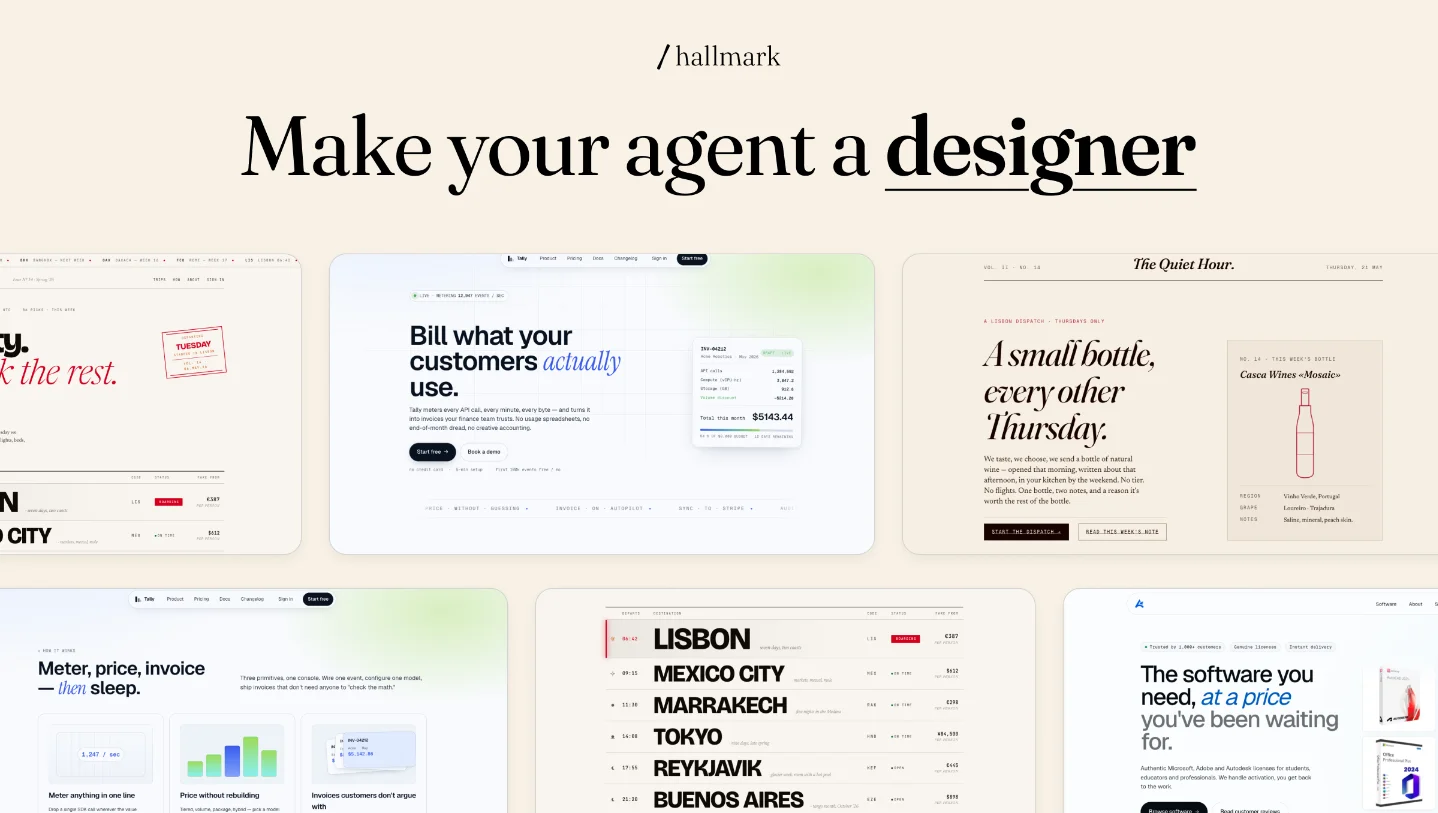
hallmark: give your agent actual design taste
Hassan El Mghari (Together AI) released hallmark on May 21 — an MIT-licensed design skill for Claude Code, Cursor, and Codex that hit 1,500 GitHub stars in under 30 hours. It solves the AI slop problem by forcing agents to pick from 21 named page macrostructures and 22 OKLCH-themed palettes before generating any HTML, then runs 69 anti-pattern gates before handing code back. The `study` verb — which extracts design DNA from any URL or screenshot into a portable design.md — is its clearest differentiator from Anthropic's frontend-design. Full install steps, honest comparison table, and a "when not to use" section.

Research Brief
Every AI-generated landing page looks like the same landing page. Purple-to-pink gradient hero. Inter on Inter. Three icon-tile feature cards in a row. Sticky nav with wordmark left, CTA button right. You've seen it a thousand times because every LLM was trained on a thousand pages that look exactly like that.1
Prompting your way out doesn't work. When you type "make it look nice," the model hears "average of training data" — it picks from the same peak every time.2 hallmark (by Hassan El Mghari / Together AI, MIT) puts a rules layer on top of your agent that forces it off that distribution before a single line of HTML is written.3
Released May 21, 2026, it hit 1,500 GitHub stars in under 30 hours.4 Supports Claude Code, Cursor, and Codex.
What it does
hallmark exposes four verbs that cover the full design workflow:
| Verb | What it does |
|---|---|
hallmark build | Default. Picks one of 21 named page structures (macrostructures), dresses it in one of 22 themes, then runs 69 anti-slop checks before handing code back |
hallmark audit <target> | Scores existing code against the 69-gate catalog. Returns a punch list — no auto-edits |
hallmark redesign <target> | Keeps your copy, IA, and brand; throws out the current layout and rebuilds with a different structural fingerprint |
hallmark study <url|screenshot> | Extracts design DNA from any page or screenshot and produces a portable design.md you can apply to your own project |
The SKILL.md itself is intentionally plain:5
"Hallmark is opinionated, short, and boring on purpose. It encodes a tight set of rules — drawn from the consensus of the anti-AI-slop design field — and refuses to let the model fall back to the defaults every LLM was trained on."
The structural diversity claim is the key differentiator. Two builds from two different briefs produce different page shapes — not just different color swaps on the same hero → 3-feature → CTA → footer skeleton.3 hallmark tracks the last 3–5 runs in
.hallmark/log.json and blocks reuse of the same macrostructure or theme cluster — so repeated builds on the same project stay structurally distinct.5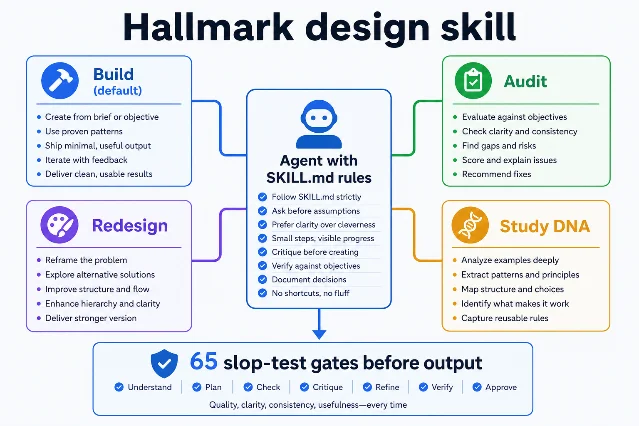
Install (60 seconds)
npx skills add nutlope/hallmarkRe-run anytime to update. The installer detects your agent and places files accordingly:3
- Claude Code →
~/.claude/skills/hallmark/ - Cursor →
.cursor/rules/hallmark.mdc(SKILL.md body only — strip the---YAML frontmatter) - Codex →
~/.codex/skills/hallmark/(personal) or.codex/skills/hallmark/(project-scoped)
No prerequisites, no runtime dependencies. The skill is plain Markdown context loaded by the agent.
One thing to know before you start building: hallmark reads your existing font stack, palette, motion stance, and spacing scale before asking anything.5 If you already have a design system, it won't bulldoze it.
hallmark study: the standout feature
build and redesign are useful. study is the reason this skill is getting installed over alternatives like impeccable or tasteskill.7Give it a URL and it shallow-fetches the page's HTML and CSS — extracting exact font names from
@font-face or Google Fonts declarations and exact OKLCH/hex color values from the DOM. Give it a screenshot and it runs a vision pass to identify type roles, color bands, macrostructure, and component archetypes without guessing specific font names.Both modes output a structured diagnosis report. From there, three options:
- "Build with this DNA" — applies the extracted palette and type pairing to a new brief
- "Lock the DNA" — writes a portable
design.mdthat works across Claude Code, Cursor, v0, Bolt, or any other AI tool - "Just the diagnosis" — stop at analysis
Reviewer Mervin Praison called it "the main differentiator" because it bridges the gap between "I like that design" and "now build something inspired by it" without crossing into pixel-cloning.6
Loading content card…
Known blind spot: URL mode can't judge visual rhythm — it reads what's in the code, not what the eye actually sees. For anything where whitespace and proportion matter more than font/color values, use a screenshot instead.
hallmark vs. frontend-design
If you covered last week's frontend-design skill (Anthropic, May 20), you already know one strong option for fighting AI-generated visual defaults. The two skills address different failure modes.
| hallmark | frontend-design | |
|---|---|---|
| Core mechanism | 21 macrostructures + 22 themes + 69 slop-test gates | Art-director brief + ban list of AI defaults |
| Design source | Screenshot/URL DNA extraction + hardcoded rule canon | 4-question brief (audience, use case, tone, aesthetic direction) |
| Output | Self-contained HTML + CSS | Styled components inside your existing framework |
| Repetition prevention | .hallmark/log.json project memory (automatic) | Relies on user instruction |
| Unique capability | study verb (DNA extraction) | Tight integration with existing component systems |
| Agents supported | Claude Code, Cursor, Codex | Claude (built-in) |
The practical split: hallmark is stronger when you're building multiple standalone pages (different briefs, different clients) or auditing existing AI-generated code for anti-patterns. frontend-design wins when you're working inside an existing React/Vue component library or need the output to drop directly into a design system.6 They can coexist in the same repo — hallmark for greenfield landing pages, frontend-design for component-level work.
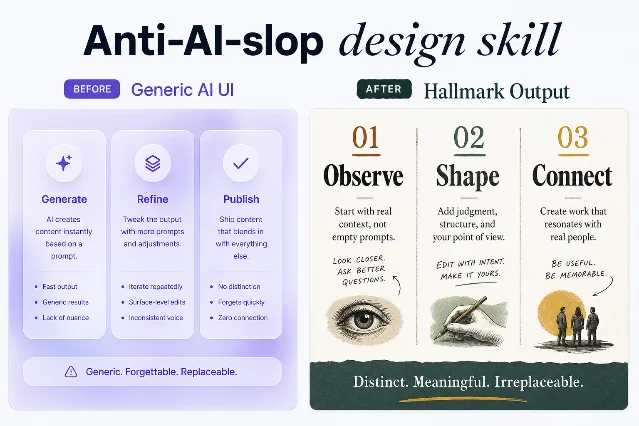
The live demo at usehallmark.com shows the before/after directly: same prompt, Sonnet 4.6 with vs. without the skill. Without hallmark: generic gradient hero, headline "Build the future. Together.", fabricated ★★★★★ trust strip. With hallmark (Marquee Hero · Atelier theme): editorial layout, italic Fraunces display, real content, no invented metrics.8
When not to use it
- Component-based frontend stacks. hallmark outputs self-contained HTML + CSS. If your project runs on React, Vue, or a design-token system, the output doesn't drop in cleanly — you'll spend more time adapting it than it's worth.6
- When you need to match an existing brand strictly. The 4pt spacing scale, OKLCH palette rules, and font pairing constraints are hardcoded and not configurable. If a client's guidelines conflict with those rules, hallmark will generate something that looks good but doesn't match their system.
- Multi-model workflows. hallmark doesn't currently support orchestrated multi-model pipelines. If your stack chains models across providers, this is a gap.9
- One-off throwaway pages. The project memory system adds value over multiple builds. For a single page you won't iterate on, the overhead of the full 7-step flow and 69-gate check is more than necessary.
A fair question from the community: does hallmark reduce AI tells, or does it help teams develop more coherent design thinking?10 The honest answer is the former, reliably. The latter depends on whether you use
audit and study as learning tools, not just one-shot generators.Skill metadata
- Repo: github.com/nutlope/hallmark
- Stars: 1,500+ (as of 2026-05-22, ~30 hours after launch)4
- Forks: 102
- License: MIT — "Use it, fork it, ship it."3
- Author: Hassan El Mghari (@nutlope), Director of Developer Experience at Together AI. Co-author: @YoussefUiUx
- Agents: Claude Code, Cursor, Codex
- Version: 1.0.0 (no published releases; ships on
main) - On the roadmap: more unique themes, image support, theme-aware motion tokens,
hallmark variant, multi-page coherence11
Cover image from Nutlope/hallmark — GitHub
References
- 1Hallmark: Fix AI-Generated UI Slop — Creative AI News
- 2@wiltodelta on X: Hallmark does not touch the weights
- 3GitHub — Nutlope/hallmark
- 4Trendshift: Nutlope/hallmark stats
- 5SKILL.md — Nutlope/hallmark
- 6Hallmark Design Skill: Anti-AI-Slop UI — Mervin Praison
- 7@Neil_Dagger on X: Hallmark — by far the best
- 8Hallmark — usehallmark.com
- 9@AIDailyGems on X: step back from agent-first development
- 10@sesigl on X: less AI tells vs. more coherent design thinking
- 11ROADMAP.md — Nutlope/hallmark
Add more perspectives or context around this Drop.